Galileo Protocol · MMXXVI
Back to Blog
counterfeitingauthenticationprovenanceluxurydpp

One Chanel Serial Number, 127 Reports, 36 Countries

September 2, 2026Pierre Beunardeau

A Chanel serial code appeared 127 times in a reseller database. The case shows why a copied identifier cannot prove which physical bag is genuine.

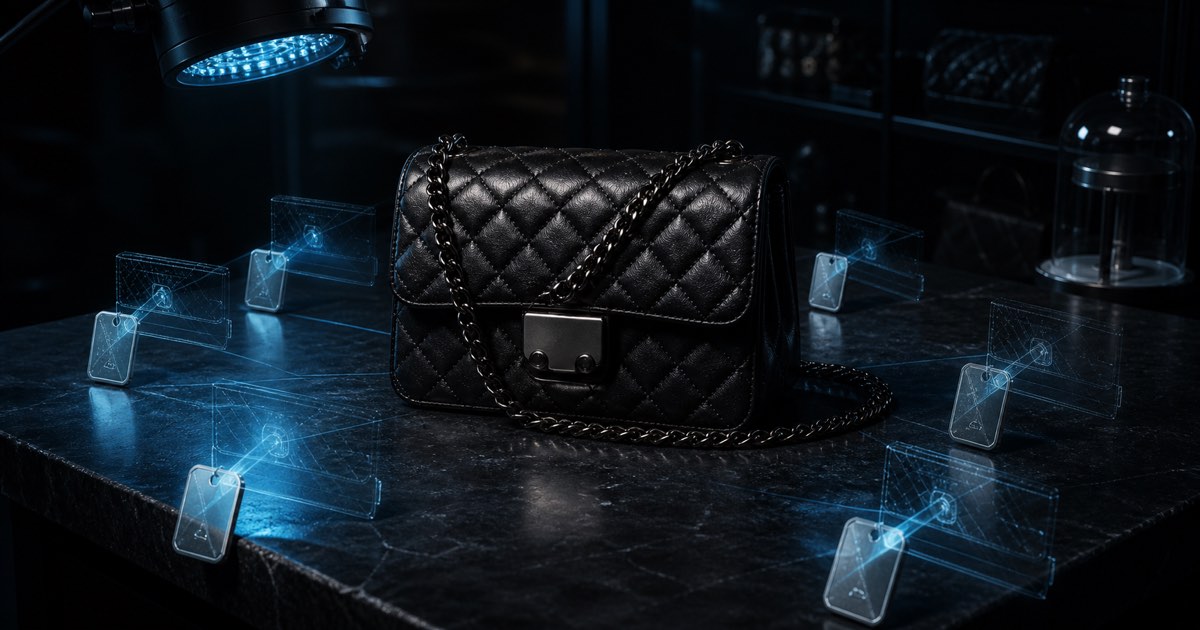
A generic black quilted luxury handbag surrounded by duplicate translucent identity tags under cyan inspection light

The number 10218184 was reported 127 times in submissions from 36 countries, according to a reseller's public database. That repetition is a powerful warning signal, but the code alone cannot prove which physical bag is genuine.

This distinction matters wherever a valuable object is sold by someone other than its maker. A serial number can help find a record. It is not, by itself, evidence that the object carrying it is the object named in that record.

What the 127 reports and 36 countries actually show

Singapore reseller Luxury Evermore maintains a public red-flag Chanel serial-number database. The page, marked last updated 21 August 2026, gives code 10218184 a count of 127. Its country field names 36 countries, from Australia and Austria to the United States and Vietnam.

The company says these observations came through its free authentication review service. Inside Retail Asia reported the finding on 25 August 2026. The report says the code appeared on several bag designs among submissions to that service.

Mingchuan Tian, founder of Luxury Evermore, described the marker's operational value to Inside Retail that day. He said: “For us as resellers and authenticators, the serial number tag or microchip serves another important purpose: Helping us identify whether a product may be counterfeit.” This is an authenticator's interpretation, not independent proof of the 127 submissions.

The database is useful, but its evidential boundary must be visible. Luxury Evermore does not publish the 127 case files, photographs, submission dates, chain of custody or authentication outcomes. An outside reader therefore cannot reproduce the count or determine how many distinct physical bags were involved.

There is also a live inconsistency inside the publisher's own record. The summary table lists 36 countries and includes Belgium. The detail page for 10218184 lists the countries again, but omits Belgium, leaving 35. This article preserves the headline figure because it is the database publisher's current summary claim. It also records the mismatch rather than silently reconciling it.

The detail page says the legitimate reference behind the code would be a black lambskin Camera Case with silver-tone metal. It gives dimensions of 19.5 × 26.5 × 8.5 cm, seasons 06P, 06C and 05A, and production in 2005-2006. Those particulars are assertions by Luxury Evermore. No public Chanel catalogue or internal record was found to confirm them, so they are not used here as verified Chanel facts.

What is established on the public record is narrower:

  • one database publisher reports 127 sightings of the same code;
  • its summary distributes those sightings across 36 named countries;
  • its detail page currently names only 35 countries;
  • the underlying submissions are not available for independent audit;
  • repeated use makes the code suspicious, but does not identify an original.

That last point is the heart of the case.

A code can be unique in a database and duplicated on objects

People often use three different ideas as if they were the same.

An identifier is a value used to distinguish a record. A serial string can perform this job perfectly inside a manufacturer's database.

An identity record is the set of claims attached to that identifier. It might describe model, material, colour, production event, service history and current status.

Proof is what lets another party test who issued those claims and whether this object is the one they concern. That requires more than reading the identifier.

A counterfeiter does not need to break a database to copy a printed code. One photograph, listing or physical example can reveal a plausible value. The string can then be printed on many objects, while each object points the human reader toward the same apparently valid story.

The database may still be correct that the identifier was meant to be unique. The failure happens outside the database, at the link between record and object. The identifier remains singular in software while becoming plural in leather, metal and stickers.

One valid-looking code, many physical objectsIDENTIFIER 10218184One lookup valueONE DATABASE RECORDThe lookup can still return a matchBAG ABAG BBAG CREPORT 127A successful lookup proves the code was read, not which bag owns it.

What Chanel itself promises, and what it does not

An older official Chanel care document for handbags describes the paper-era mechanism. It says each handbag is unique and comes with an individual identification card. It also says the card number is marked inside the item.

That document tells owners how the mechanism was intended to work. It does not publish a consumer-verifiable register, an issuer signature or a way to distinguish a copied card-and-sticker pair from the original pair.

Chanel's current United States fashion FAQ draws a firmer commercial boundary. It says authentication is not a service the house offers. It guarantees authenticity only for products purchased from a Chanel boutique or an authorised retailer listed in its store locator.

The two official texts are compatible. A house can assign an individual number to every object it makes while declining to authenticate objects presented later through an open public service. The first is an internal production and after-sales capability. The second would be an external trust service for an enormous secondary market.

For a buyer, the result is practical. A readable number is not a Chanel authentication response. A seller saying “the serial checks out” has usually shown only that the visible value fits a known format or period.

The company has not published enough current handbag documentation to support stronger claims about its post-2021 identification architecture here. Inside Retail describes a shift to a microchip-based system, but that remains secondary reporting for this article. We do not treat the presence, behaviour or security properties of a current chip as an official Chanel fact.

A red-flag database answers a different question

The Luxury Evermore list does something valuable. It turns scattered observations into a reuse warning. A reseller who encounters 10218184 can stop, compare the object with the claimed reference and commission deeper examination.

But the list answers “has this value appeared suspiciously often?” It cannot answer “which one is original?” The count grows by sightings, not by cryptographically verified identities.

That distinction changes the decision path:

  1. A code-format check asks whether the value looks plausible.
  2. A reuse search asks whether the value has appeared on conflicting objects.
  3. A physical examination asks whether materials, construction and ageing fit the claimed product.
  4. A provenance check asks where the seller obtained the bag and whether transaction evidence is coherent.
  5. An issuer-verification check asks whether the maker signed an item-level record that is still valid.
  6. A physical-binding check asks whether the responding carrier is still inseparable from the object that received it.

Most consumer serial lookups stop after steps one or two. Professional authentication may add three and four. A verifiable identity system is designed to make five available outside the issuer. It still needs serious engineering to make six credible.

This is also why automation can fail in both directions. In an unrelated Reddit thread dated 5 August 2026, user Loud-Aerie4711 described a disputed marketplace rejection and wrote: “They used AI to say my receipt was AI.” The claim is an unverified customer account, not evidence about the platform's process. It illustrates the cost of a system that returns a verdict without exposing a checkable chain of evidence.

A false acceptance lets a counterfeit through. A false rejection blocks a genuine owner. Better identity infrastructure does not eliminate expert judgement, but it can make the inputs and issuer claims inspectable.

What a stronger item identity needs

A dependable architecture separates five layers. Each layer answers a question the copied string cannot.

1. Granularity. Is the identifier assigned to a model, a production batch or one physical item? “Unique” has little meaning until the system states the population within which uniqueness applies.

2. Issuer authority. Who created the record? The house should sign the identity claim with a verifiable key. A reseller should be able to confirm that signature without trusting a screenshot or the seller's app.

3. Data carrier. How is the identifier presented on the object? A QR code, data matrix, NFC tag, secure chip or material marker can carry or reveal it. The choice affects cost, durability and resistance to copying.

4. Physical binding. What stops a genuine carrier being copied, relayed or transplanted into another object? Tamper evidence, construction choices and challenge-response hardware can raise the attack cost. None makes the problem disappear.

5. State and events. Can the record show issuance, sale, service, loss, theft, recall or retirement without exposing the owner's private data? A static birth certificate is weaker than a record whose status can be checked at the transaction moment.

From a serial string to a verifiable item identity1 · GRANULARITYModel, batch or one item?Define what “unique” means.2 · ISSUERThe house signs the claim.Anyone can verify its origin.3 · CARRIERQR, NFC, secure chip or marker.Expose the identifier durably.4 · BINDINGConnect carrier and object.Resist copies and transplants.5 · STATEIssue, service, transfer, retire.Check status at the transaction.All five are needed. A scan screen alone is not proof.

Where GS1 Digital Link helps, and where it stops

The GS1 Digital Link standard provides a consistent way to express GS1 identifiers in web addresses. Its companion resolver standard lets those identifiers point to one or more sources of related information or services.

This solves an important interoperability problem. A product identifier can travel in a web-compatible form rather than being trapped inside one proprietary app. The same address can connect a scanner to instructions, product data, traceability resources or a service endpoint.

The current GS1 Digital Link URI Syntax specification is explicit about the boundary. A conforming URI, like any URL, has no intrinsic meaning on its own. Applications cannot assume even that it points to a conformant resolver.

The security conclusion follows from the standard's scope. URI syntax proves that a string is well formed. Resolution proves that a service returned information for that string. Neither operation proves that the handbag under the scanner is the object to which the issuer assigned the identifier.

An open identifier and resolver are therefore necessary rails, not an authenticity verdict. Issuer signatures, carrier security, physical binding and current status must sit on those rails.

What the EU Digital Product Passport really requires

The Ecodesign for Sustainable Products Regulation, Regulation (EU) 2024/1781, creates the legal framework for Digital Product Passports. It does not yet impose one item-level passport on every luxury handbag.

Article 9(2)(d) says the relevant delegated act must specify whether a passport corresponds to the model, batch or item level. Granularity is a product-group decision. Calling the framework universally item-level would overstate the law.

Article 10 sets technical requirements for a passport. The data carrier must be physically present on the product, packaging or accompanying documentation, as specified by the delegated act. It must be connected to a persistent unique product identifier. The passport must also use open standards and interoperable formats.

Article 11 requires passport design and operation to provide data authentication, reliability and integrity. It also addresses security, privacy and fraud avoidance. Article 12 sets standards for operator and facility identifiers, plus fallback rules for issuing and maintaining identifiers and carriers.

These provisions create a stronger information architecture than an isolated serial sticker. They tell future product rules to define granularity, carrier placement, persistent identifiers, access and governance.

They do not repeal the physical-binding problem. A printed carrier can be copied. A genuine tag can be moved. A resolver can show authentic data after a counterfeit object presents a cloned address. Compliance data and object authenticity overlap, but they are not identical claims.

For a luxury house, the practical design choice is to build beyond the minimum carrier requirement. Use the passport identifier as the index, then add issuer-signed claims and a carrier whose response is difficult to duplicate. Record lifecycle events without making the owner's identity public.

The reseller checklist: search key first, evidence second

A reseller should never discard a serial code. It should change what the code is allowed to prove.

At intake: photograph the object and identifier together. Preserve seller declarations, transaction documents and timestamps. A detached close-up of a code loses the relation to the submitted bag.

At lookup: test format and expected period, then search internal and external reuse records. A conflicting model, colour or geography raises risk. It does not establish criminal intent or settle authenticity by itself.

At examination: compare construction, materials, hardware, dimensions, wear and repairs with known references. Record the expert, method and confidence. Do not collapse a multi-factor assessment into “serial valid”.

At issuer proof: if a house-backed record exists, verify its issuer signature and current status. Do not trust a screenshot, a copied certificate image or a branded landing page merely because it loads.

At physical binding: test the carrier's security properties. A secure chip should answer a fresh challenge, not replay a fixed string. The attachment should reveal removal or transplantation where the product permits it.

At sale: give the buyer the evidence bundle and its limits. Transfer the item record when the system supports ownership events. Keep personal details outside any public ledger.

This workflow makes uncertainty explicit. A reused code can trigger escalation without pretending a crowd-sourced list is a court finding. A successful issuer check can strengthen the file without pretending a chip makes material expertise obsolete.

The maison checklist: issue authority once, preserve it through resale

For a maison, the lesson is not “replace the sticker with a chip.” A static value inside an NFC tag can reproduce the same failure in a more expensive component.

The stronger target is an identity that survives channel changes:

  • assign at item level when the value proposition or product rule requires it;
  • sign the record with an issuer key whose authority can be verified independently;
  • use a carrier appropriate to the item's lifespan, service environment and attack model;
  • design the carrier and product together so removal leaves evidence;
  • expose status without exposing the customer's name;
  • support service, repair, loss and retirement events;
  • let ownership transfer without rewriting the original manufacturing claim;
  • publish verification rules and failure states for resellers and auction houses;
  • retain a recovery path when a carrier fails on a genuine item.

The final point is easy to miss. Luxury goods outlive phones, apps and sometimes technology providers. A secure identity must be repairable without making silent replacement an authenticity loophole.

What no digital identity can promise

There is no perfect anti-counterfeit carrier.

A QR code is cheap and accessible, but trivially photographed. A basic NFC tag improves the experience, but may expose a static response. A cryptographic chip can resist copying, yet still be relayed or physically transplanted. Tamper evidence can raise the cost of removal, but artisans can attack seams and components.

Issuer systems can also fail. Keys can be compromised, access can be abused and incorrect data can be signed. A technically valid claim is only as trustworthy as the issuer's controls and correction process.

Privacy creates another constraint. A buyer needs to know that a bag is genuine, active and transferable. They do not need a public list of every prior owner, address or purchase price. Provenance should mean verifiable events, not permanent consumer surveillance.

Finally, not every legacy bag can receive a birth record from its maker. Retrospective authentication remains an expert judgement made later. A system should label that distinction instead of presenting a later appraisal as original issuance.

The correct promise is modest and valuable. Digital identity can make issuer claims portable, checks reproducible and lifecycle state visible. It can sharply reduce reliance on a copied string. It cannot turn every scan into certainty.

Galileo's take

The 10218184 case is not mainly a story about one suspicious number. It is a demonstration of the distance between an identifier and an identity. A database of sightings detects reuse. An expert assesses the object. An issuer-signed record establishes who made a claim. A secure physical anchor connects that claim to the item presented today.

Those functions should reinforce one another. None should impersonate the others.

Galileo Protocol builds the portable record layer for physical assets: verifiable digital twins, issuer attestations and interoperable lifecycle events. The architecture is designed so a buyer can inspect the authority behind a claim, while personal data remains outside the public record.

Explore the Galileo Protocol documentation, read the open specifications, or contact the team to discuss item-level identity for luxury goods.

Sources

FAQ

Does Chanel serial number 10218184 prove that a bag is fake?

No. Luxury Evermore reports seeing that code 127 times in submissions from 36 countries, which makes it a warning signal. The public database does not expose the underlying submissions for independent review. A copied code also cannot identify which physical bag, if any, received it legitimately. The bag, its construction, its provenance and the seller must still be examined.

Can Chanel authenticate a pre-owned handbag?

Chanel's United States fashion FAQ says product authentication is not a service the house offers. It says authenticity is guaranteed only for products bought from a Chanel boutique or an authorised retailer. That leaves a secondary-market buyer relying on seller evidence, specialist examination and any product record made available by the issuer.

Is a microchip stronger than a printed serial number?

It can be, but only if the chip does more than reveal a static value. A static NFC response can be copied or relayed. A stronger design uses a chip that proves possession of a secret through a changing cryptographic challenge. The design must also bind that chip to the bag so it cannot be transplanted without detection.

Does the EU Digital Product Passport require one unique identity per luxury bag?

Not automatically. Article 9 of the ESPR says a delegated act must decide whether a passport applies at model, batch or item level. Articles 10 to 12 establish the data-carrier and identifier architecture. A future product rule could require item-level granularity, but the framework itself does not yet impose that level on every handbag.

What should a reseller verify before accepting a luxury bag?

Treat the visible code as a search key, not a verdict. Check whether it matches the product family and production period, search for reuse, inspect the physical object, and verify seller evidence. Record who performed each check. If an issuer-signed item record exists, verify its signature, status and physical binding rather than trusting the scan screen alone.